

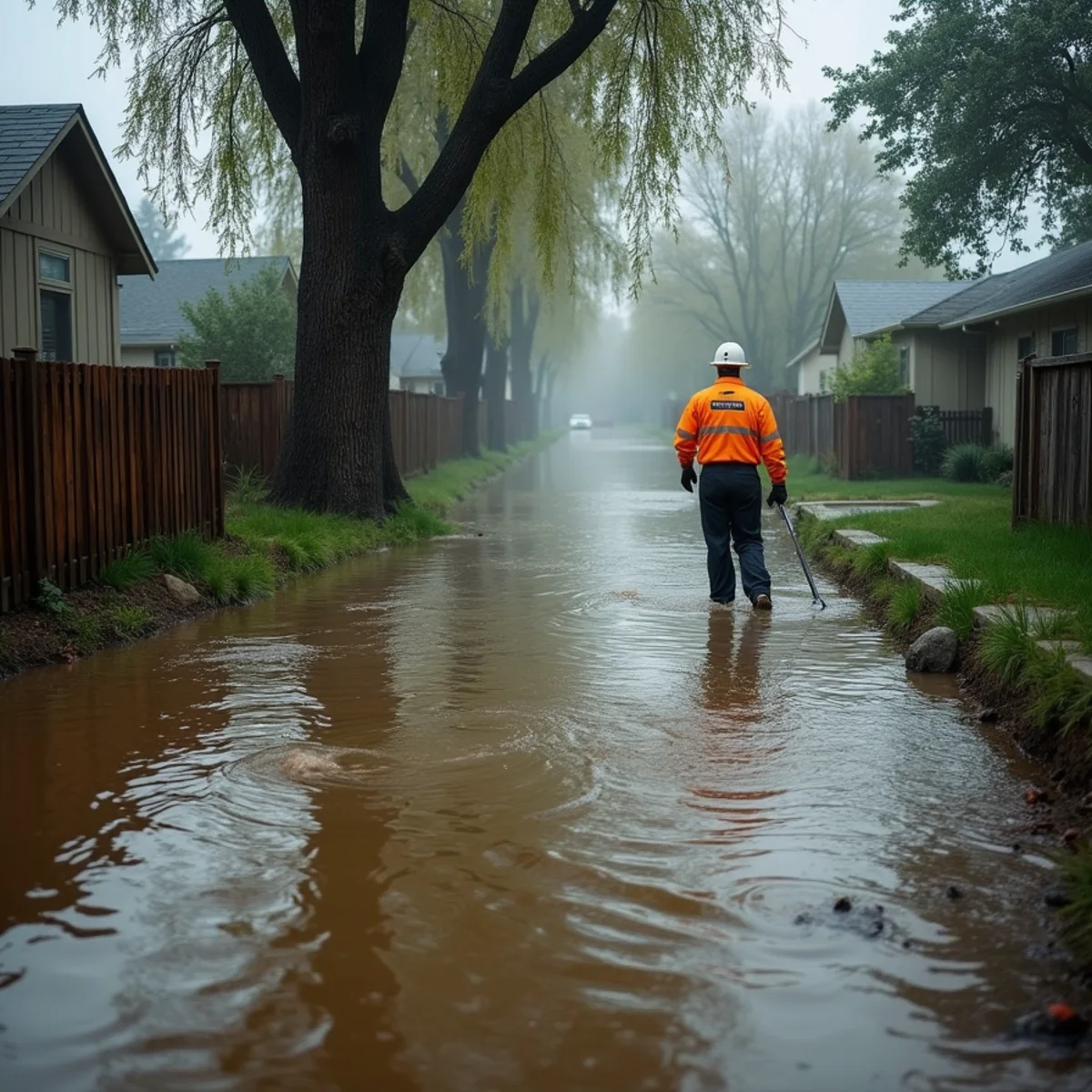
In February 1986, a cloudburst pushed Antelope Creek and Secret Ravine into about ten Rocklin homes. The storm is history, but the drainage geography behind it has not changed.
A Storm Rocklin Still Measures Against
Every region has a storm it remembers. For Rocklin and the surrounding Placer County, one of them arrived in February 1986. A cloudburst — an intense, concentrated downpour — dropped more water on the foothills than the creeks could carry. Along Antelope Creek and Secret Ravine, water rose out of the channels and into homes. About ten Rocklin houses flooded, and countywide the storm caused an estimated 7.5 million dollars in damage.
Nearly four decades later, that event is still a useful reference point. It was not a freak that could never recur; it was the local drainage system meeting more rain than it was built to handle, exactly the scenario that repeats every few decades in the Sierra foothills.
Looking back at what happened, and why, tells Rocklin homeowners a lot about the risk that is still with them.
What Happened in February 1986
The February 1986 storm sequence was one of the more significant flood events in Northern California's modern record, driven by a series of powerful, moisture-laden systems. In Rocklin, the water concentrated where it always concentrates — in the natural drainage channels that thread through town. Antelope Creek and Secret Ravine, quiet most of the year, filled and overtopped.
Roughly ten homes took floodwater. For the families in them, a normal creek at the edge of the property became the source of a serious loss overnight. The countywide damage figure of around 7.5 million dollars reflects how widely the storm's effects spread beyond those individual houses — roads, infrastructure, and property across Placer County.
It was the kind of event that reshapes how a community thinks about its creeks.
Why Antelope Creek and Secret Ravine Flooded
The flooding was not random. Antelope Creek and Secret Ravine are natural channels that collect stormwater from a large area and carry it downhill. They are efficient at moving ordinary rain. In a cloudburst, the volume arrives faster than the channels can pass it along, and the water backs up and spreads laterally into the flatter ground and homes beside the creek.
Rocklin's granite geology contributes. With bedrock close to the surface across much of the area, soil absorbs only so much before runoff sheets toward the creeks. A concentrated downpour on already-saturated ground has almost nowhere to go but the channels — and when those fill, the overflow finds the lowest nearby structures.
The homes that flooded in 1986 were, for the most part, the ones sitting lowest and closest to the water. Geography made them vulnerable, and an extreme storm did the rest. The same low, creek-adjacent lots carry that vulnerability today, which is why local flood planning still singles them out four decades later.
Placer County's Longer Flood Record
The 1986 cloudburst was not an isolated chapter. Placer County has recorded a long history of flooding, with seven federal flood disaster declarations since 1964. Each one marks a storm severe enough to draw federal recognition and aid. The creeks that run through Rocklin have been part of that story repeatedly.
The benchmark event came in January 1995, when a storm estimated at roughly a 200-year magnitude hit the region. A 200-year storm does not mean one every two centuries; it means a storm with about a one-in-200 chance in any given year. Those odds are small, but they are not zero, and the region has now seen several outsized storms within living memory.
The Placer County Flood Control District manages Secret Ravine, Antelope Creek, and Dry Creek precisely because this history is real. The infrastructure and planning exist to reduce, not eliminate, the risk that 1986 and 1995 demonstrated.
What the 1986 Cloudburst Teaches Rocklin Today
History is only useful if it changes what you do. The value of remembering 1986 is not nostalgia; it is the specific, repeatable pattern the storm revealed — where the water goes, how fast it arrives, and which homes are exposed. Four decades of growth have added houses and roads to the same drainage geography, but they have not changed the creeks or the granite beneath them. The lessons carry forward almost unchanged:
The practical lessons of the 1986 cloudburst have not expired:
- Creeks that look harmless most of the year can flood homes in a single storm
- Low-lying and creek-adjacent properties carry the most exposure
- Standard homeowners insurance usually excludes this kind of outside flooding
- An extreme storm can arrive on already-saturated winter ground with little warning
- Fast, professional cleanup limits how far storm water damage spreads
How Four Decades of Growth Changed the Runoff Equation
One thing has changed since 1986, and it does not cut in the homeowner's favor. The tract booms that filled Rocklin through the 1990s and 2000s replaced open ranch land and absorbent soil with roofs, driveways, streets, and parking lots. Every hard surface that cannot soak up rain sends its share straight to the storm drains and creeks. More impervious ground means water reaches Antelope Creek and Secret Ravine faster and in greater volume than it did the year those ten homes flooded.
Modern drainage design and the Placer County Flood Control District's work are built to manage that added load, and for ordinary storms they do. But the underlying arithmetic is unchanged: a fixed set of creeks now drains a far more developed watershed. In the extreme storm, the cloudburst or the atmospheric river, the same low, creek-adjacent lots that flooded in 1986 remain the most exposed, and the water arrives at them a little quicker than it used to.
Flood-Ready Across Placer County
The February 1986 cloudburst is a reminder that Placer County's creeks command respect. Rocklin has grown a great deal since then, but the drainage geography that flooded those ten homes along Antelope Creek and Secret Ravine has not changed. Storm flooding is different from a clean pipe leak — the water is treated as contaminated, and drying has to be thorough to prevent mold.
A 200-year storm and a February cloudburst are not annual events, which is exactly why homeowners let their guard down between them. But the odds in any single winter are never zero, and an atmospheric river can turn a quiet creek into a threat within hours. The households that come through best are the ones who prepared while the sun was out and knew who to call the moment water crossed the threshold.
When a winter storm sends water into a home anywhere in Placer County, the response needs to be immediate. Our crews know these watersheds and the way foothill storms behave. Call (201) 277-9344 for 24/7 flood cleanup — we will extract, sanitize, dry, and restore.
Need help right now in Rocklin? Our line is open 24/7.
(201) 277-9344Frequently asked
About ten Rocklin homes flooded along Antelope Creek and Secret Ravine during the February 1986 cloudburst, part of an event that caused an estimated 7.5 million dollars in damage across Placer County.
Yes. Placer County has had seven federal flood disaster declarations since 1964, including a roughly 200-year storm in January 1995. The creek geography that flooded homes in 1986 is still in place.
Usually not. Outside flooding is typically excluded from standard policies and requires separate flood insurance. We document storm losses carefully to support whatever coverage applies. Call (201) 277-9344 for cleanup.
A cloudburst is a sudden, intense downpour that drops a large amount of rain over a small area in a short time. The February 1986 event overwhelmed Rocklin's creeks exactly that way, pushing Antelope Creek and Secret Ravine into about ten homes. Foothill terrain is prone to them.
Get people and pets to safety, avoid contact with the water since storm flooding is treated as contaminated, and photograph everything before cleanup for your records. Then call for professional extraction and drying fast. Call (201) 277-9344 any hour for flood cleanup across Placer County.
Related help from our team
Restoration Rocklin CA
IICRC-Certified Water Damage Restoration Team
We're a locally based, IICRC-certified water damage restoration team serving Rocklin and Placer County 24/7. Questions about your situation? Call (201) 277-9344.