
The granite that built Rocklin and became Quarry Park Adventures still shapes how water drains here. Homes in the historic quarry area have drainage needs worth understanding before the storms.
Rocklin Was Built on Granite — Literally
Rocklin's name and history are written in stone. The town grew up around its granite quarries in the late 1800s, and Rocklin granite went into buildings and foundations across California. That industry defined the community for generations. Today its most visible legacy is Quarry Park Adventures, an adventure park built into a historic quarry pit right in the heart of town.
The granite is not just history. It is still under everyone's feet, close to the surface across much of Rocklin, and it shapes something very practical: where water goes when it rains. A town built on bedrock drains differently than one built on deep soil.
For homeowners in the quarry area, understanding that geology explains a lot about local water behavior.
From Quarry to Quarry Park Adventures
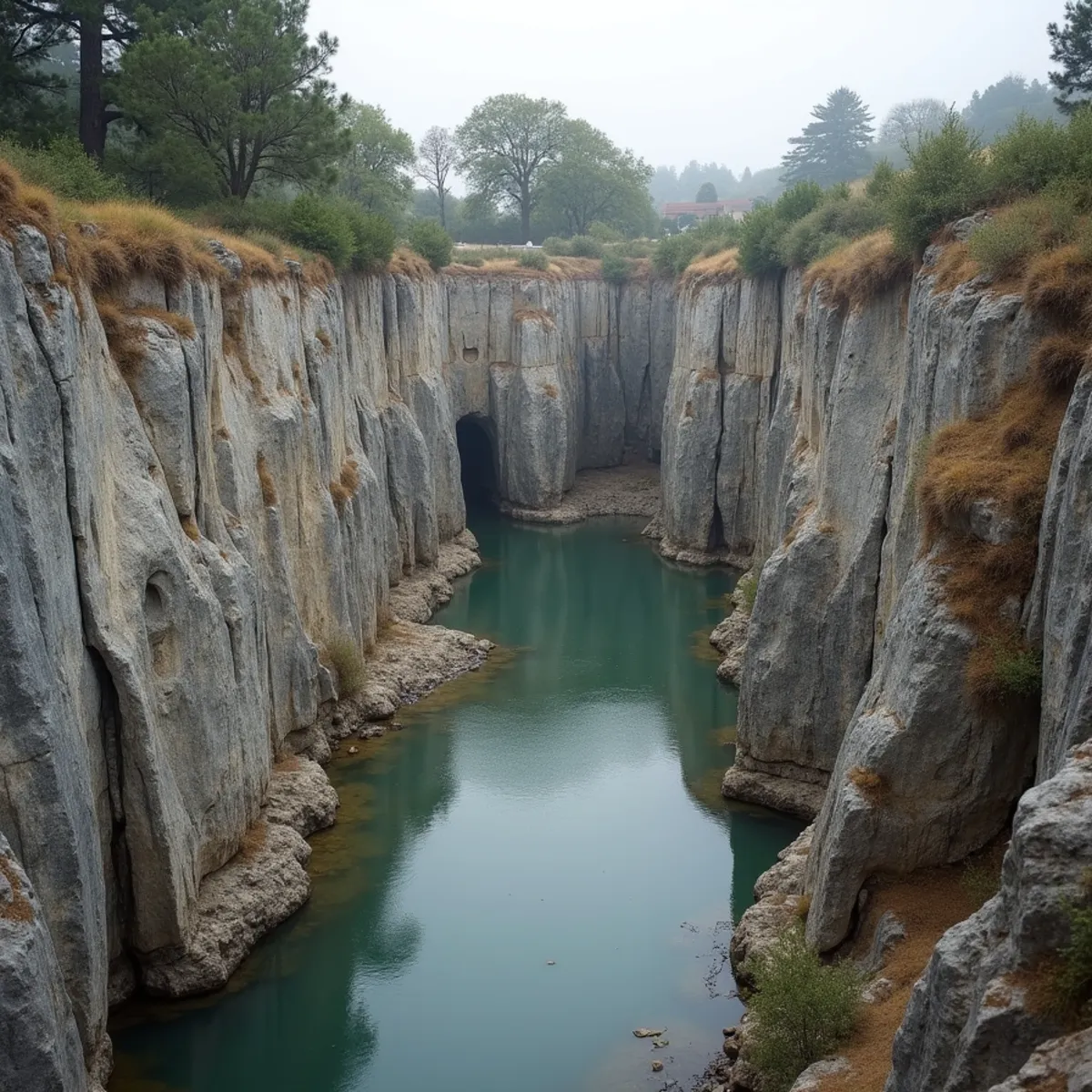
The quarries that made Rocklin famous carved deep into the granite, leaving behind pits, rock faces, and an altered landscape. When the industry wound down, those features remained. One of the largest historic quarry sites has been transformed into Quarry Park Adventures, where the old rock walls now host ziplines, climbing, and events. The park is a fitting monument to the stone that built the town.
Around and beyond the park, the granite that the quarries exposed continues to influence the terrain. Old excavation left uneven ground, rock outcrops, and low areas that collect water. Development has worked around and over this landscape for more than a century.
The result is a part of Rocklin where the interaction between rock, water, and homes is more complicated than a typical flat subdivision.
How Granite Bedrock Changes Where Water Goes
The single most important fact about Rocklin's drainage is that granite bedrock sits close to the surface. Water needs soil to soak into, and where bedrock is shallow, there is little soil to absorb a downpour. Instead of percolating down, rain runs off across the surface toward the lowest available path.
This makes Rocklin a fast-draining town in most conditions, which is generally a good thing. But it also means that during a heavy storm, water moves quickly and collects in low spots rather than dispersing into the ground. A yard that seems fine in a drizzle can channel a surprising volume during an atmospheric river.
Near old quarry ground, where excavation created depressions and exposed rock, these effects are amplified. Water finds the low points, and if a home sits near one, it can see runoff it never expected.
The Old Quarry Landscape and Modern Drainage
Building homes and neighborhoods over a former quarry landscape requires careful grading and drainage design, and Rocklin's development has generally accounted for it. But the underlying reality remains: shallow rock, uneven historic terrain, and limited natural absorption. Engineered drainage carries the load that the ground cannot.
When that engineered drainage is overwhelmed — by an extreme storm, a clogged system, or debris — the water reverts to following the old contours of the land. Low areas that were part of the quarry landscape can collect water quickly. Homes near them need their own drainage kept clear to stay ahead of it.
This is not a reason for alarm. It is a reason to know your specific lot: where it sits relative to the slope, where water pools, and how quickly it clears after a storm.
What This Means for Homes in the Quarry Area
Living on Rocklin's granite comes with a trade-off worth understanding. For most of the year, and in most storms, the fast-draining ground is an advantage — water clears quickly and standing water is rare. The catch shows up only in the biggest events, when the same ground that sheds water so efficiently sends it racing toward the low points instead of soaking it away. Homes in the quarry area are not at constant risk; they are at concentrated risk during the handful of storms each winter that overwhelm the ordinary drainage. Knowing that pattern tells you when to pay attention and what to keep clear:
If you live in or near the quarry area, a few things deserve attention each wet season:
- Keep gutters, downspouts, and yard drains clear so runoff has a fast exit
- Learn where water collects on your lot during the first storms
- Watch low-lying garages, basements, and crawl spaces, which fill first
- Grade landscaping to move water away from the foundation
- Act quickly if runoff starts entering the home during a heavy storm
Shallow Granite, Crawl Spaces, and Standing Water
There is a second consequence of building on shallow granite that homeowners feel most in the wet season: water that cannot drain down has to drain sideways, and sometimes it collects where you least want it. In a valley-floor town, a French drain or a perimeter drain sheds water into deep, absorbent soil. Over shallow bedrock, that water has less room to disappear into, so it can back up against foundations, pool in low crawl spaces, and linger after a storm instead of percolating away.
For quarry-area homes with a crawl space or a below-grade garage, that means standing water is a real possibility in a big storm, and standing water against a foundation does not stay outside forever. It wicks into framing and slabs and feeds the musty, humid conditions that lead to mold. Keeping perimeter and yard drains clear, and knowing whether your crawl space has ever held water, is the practical response to ground that sheds rain sideways rather than down.
Water Help Near Quarry Park and Rocklin's Granite Heart
The granite that built Rocklin is a point of pride and, when the storms come, a factor in how water moves through the quarry-area neighborhoods. Homes here drain fast most days and can catch fast-moving runoff in the biggest storms. When storm runoff gets inside, it is treated as potentially contaminated and tends to reach more of the structure than expected.
The granite under the quarry area is not going anywhere, and neither is the way it moves water. What you can change is how ready your particular lot is to meet a heavy storm. A garage that flooded last winter will flood again under the same conditions unless the drainage around it is corrected, and a low corner that pooled once will pool every time the system backs up. Treating the first flood as information rather than bad luck — and fixing the path the water took — is how quarry-area homeowners stop the same loss from repeating year after year.
If water gets into your home near Quarry Park, the quicker the response, the smaller the loss. Our local crews know this ground and how it sheds water. Call (201) 277-9344 for flood cleanup — extraction, sanitizing, and drying handled start to finish.
Need help right now in Rocklin? Our line is open 24/7.
(201) 277-9344Frequently asked
Granite bedrock sits close to the surface across Rocklin, including the historic quarry area. Shallow rock absorbs little rain, so water runs off quickly and collects in low spots during storms.
It is an adventure park built into one of Rocklin's historic granite quarry pits, a reminder of the stone industry that founded the town. The surrounding granite still shapes local drainage.
Keep drains and gutters clear, grade water away from the structure, and call fast when water gets in. Call (201) 277-9344 for flood cleanup before it spreads into finished space.
Not at constant risk, but the historic quarry terrain left uneven ground and low spots that collect water, and shallow granite limits how fast it drains away. In the biggest storms those low areas can flood quickly. Knowing where water pools on your specific lot is the best protection.
Shallow granite bedrock keeps water from soaking downward, so it can back up against foundations and settle into low crawl spaces. Left standing, it wicks into framing and feeds mold. Call (201) 277-9344 for flooded crawl space cleanup before it spreads into finished rooms.
Related help from our team
Restoration Rocklin CA
IICRC-Certified Water Damage Restoration Team
We're a locally based, IICRC-certified water damage restoration team serving Rocklin and Placer County 24/7. Questions about your situation? Call (201) 277-9344.