
Mildew sits on the surface and wipes away. Mold goes deeper and comes back. Knowing which one you are looking at tells you whether to grab a cloth or call a professional.
Mildew Sits on the Surface. Mold Goes Deeper.
People use mold and mildew as if they mean the same thing. For deciding what to do about a spot on your wall, they do not. The practical difference is depth. Mildew grows flat on the surface of a material. Mold grows into it.
That single distinction drives everything else. Mildew you can often wipe away yourself. Mold that has rooted into drywall, wood, or grout is not a wiping job, and trying to clean it can spread spores and make it worse.
So the first useful question is not what species it is. It is whether the growth is on the surface or in the material. Once you know that, the right response gets clear.
How to Tell Them Apart
You can make a reasonable field call with your eyes and a little care. None of this replaces a professional assessment, but it tells you how seriously to take what you are seeing. Do it in good light, and if you have any doubt about disturbing it, keep your distance rather than getting close to sniff or scrub, since agitating real mold is exactly what sends spores into the air.
Look at the color, the texture, the location, and how it behaves when you clean a small spot. The differences are usually visible.
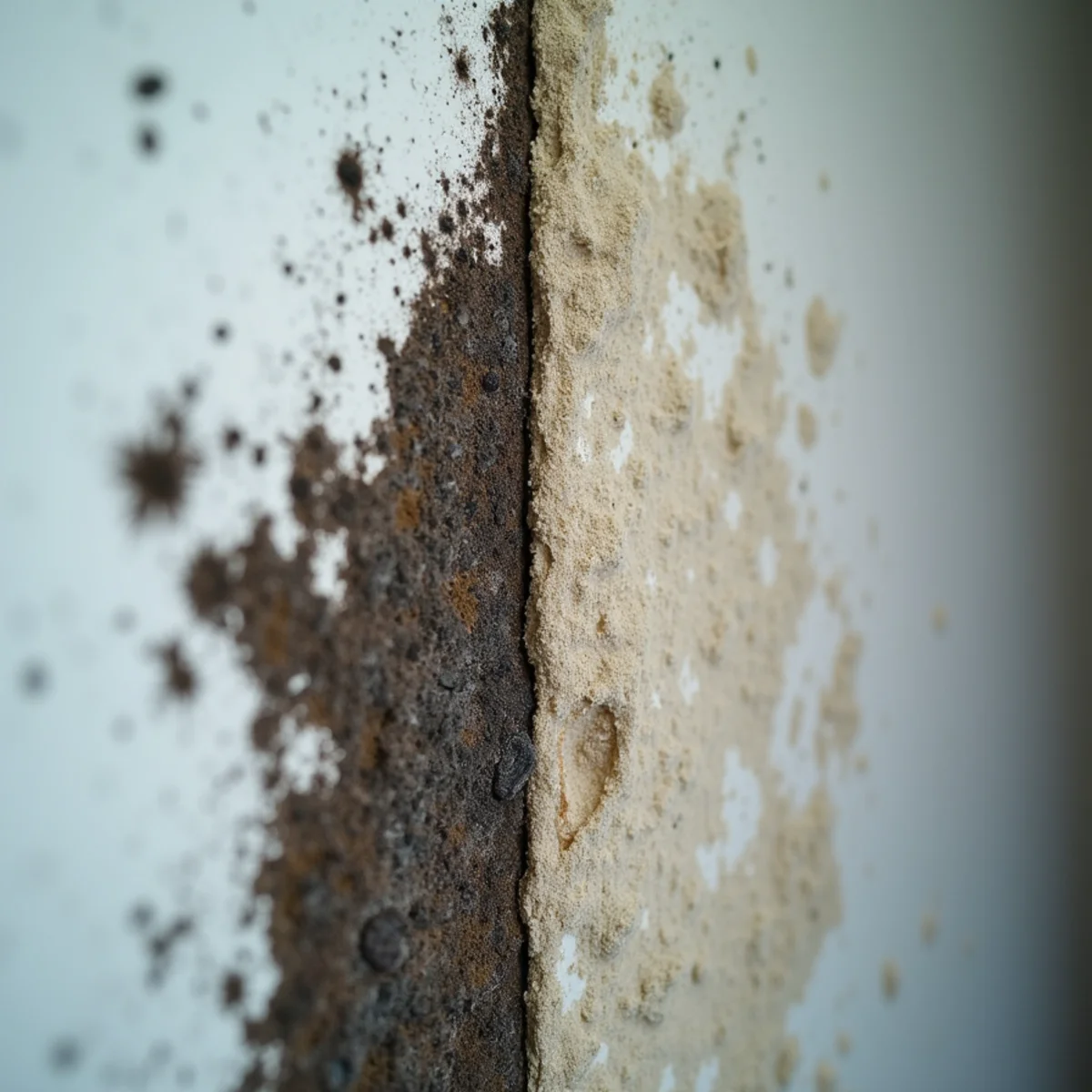
- Mildew is typically gray or white and looks powdery or fluffy on the surface
- Mold is often black, green, or brown and can look slimy or fuzzy
- Mildew stays flat on the surface; mold appears raised and rooted in
- Mildew wipes off with cleaner; mold returns or leaves a stain behind
- Mildew favors damp surfaces like tile and glass; mold favors porous drywall and wood
- A strong, persistent musty smell points toward mold rather than mildew
The Black Mold Question
The phrase black mold gets a lot of fear attached to it, often tied to one particular species. The more useful truth is broader. Any significant indoor mold growth can affect your air quality and health, regardless of the exact species, and it should be handled the same careful way.
Color alone does not identify a species, and you cannot tell how hazardous a growth is just by looking. What matters is that mold rooted into your materials, dark or otherwise, means moisture has been present long enough for it to establish. That is the real signal.
So do not get stuck on whether a patch is the black mold. Focus on whether it is mold at all, how much there is, and why it is there. Testing for a specific species rarely changes what needs to happen next, since the response to any real growth is the same: contain it, remove it safely, and fix the moisture that fed it.
When You Can Handle It Yourself
Some situations are genuinely a do-it-yourself job. A small patch of surface mildew on non-porous bathroom tile or glass, caught early, can usually be cleaned safely with proper ventilation and standard cleaner. Keep the area dry afterward and it often does not return.
The key limits are size, surface, and cause. Small, surface-only, on a non-porous material, with an obvious and easily fixed moisture source like a poorly ventilated shower. Inside those limits, you can handle it.
If you clean it and it comes right back, that is your answer. The moisture problem is still there, and the growth may be deeper than the surface you wiped. That is the moment to stop scrubbing and start looking for the source.
When to Call a Pro
Some growth is beyond a cloth and a spray bottle, and disturbing it without containment spreads spores through the house. That is when a professional matters. Call in help when the area is larger than a small patch, when it is on porous material like drywall or wood, when it keeps returning, or when it follows a water leak or flood. A rough rule many pros use is that anything larger than about a square yard is worth a professional look rather than a DIY scrub.
Proper mold remediation contains the work area with barriers and negative air pressure, removes affected material safely, runs HEPA air filtration, and, critically, fixes the moisture source so it does not grow back. We handle this across Rocklin, including homes in Whitney Ranch where a hidden leak turned a small spot into a wall-cavity problem.
How to Clean Surface Mildew Safely Yourself
If you have confirmed it is surface mildew on a non-porous material like tile, glass, or a sealed shower surround, you can usually handle it. Ventilate the room first, opening a window or running the exhaust fan, and wear gloves and a mask so you are not breathing what you disturb. A standard bathroom cleaner or a dish-soap-and-water solution works fine, then scrub, rinse, and dry the surface completely.
Skip the bleach on anything porous. Bleach is mostly water, so on drywall or grout it soaks in, feeds the problem, and never reaches the roots. The real fix for mildew is controlling moisture: run the fan during and after showers, wipe down wet surfaces, and keep indoor humidity down. If the growth returns within days, it is deeper than the surface you wiped, and that is your cue to stop scrubbing and call for help.
Not Sure Which You Have? Ask.
The hardest part is often just telling mildew from mold, and getting it wrong costs you either way. Scrub at rooted mold and you spread it. Call a pro for surface mildew and you paid for a wipe-down.
If you are not sure which you are dealing with, that uncertainty is itself a good reason to ask. Call (201) 277-9344 and we will tell you whether it is a wipe-it-down mildew spot or a mold problem that needs a real fix.
Need help right now in Rocklin? Our line is open 24/7.
(201) 277-9344Frequently asked
Mildew grows flat on the surface of a material, is usually gray or white and powdery, and wipes away. Mold grows into porous materials like drywall and wood, is often black or green and raised, and returns after cleaning. Depth and how it behaves when cleaned are the tells.
Any significant indoor mold growth can affect air quality and health, and you cannot judge the hazard by color alone. What matters is that mold has rooted into your materials, which means persistent moisture. Treat any real growth with the same care rather than focusing on the species.
Call a pro when the area is larger than a small patch, on porous material like drywall or wood, keeps returning after cleaning, or follows a leak or flood. Disturbing rooted mold without containment spreads spores. Reach us at (201) 277-9344 if you are unsure.
It can knock down surface mildew on non-porous materials like tile and glass, but it is not a fix for mold rooted in porous material. Bleach is mostly water, so on drywall or wood it soaks in and leaves the roots alive underneath. Real remediation removes the affected material rather than relying on bleach to reach what it cannot.
Control the moisture. Run the exhaust fan during and after showers, wipe down wet tile and glass, fix any slow leaks, and keep indoor humidity down. Mildew needs damp surfaces to grow, so a drier bathroom is one it struggles to return to. If it keeps coming back despite that, the growth is likely deeper, and it is worth a call to (201) 277-9344.
Related help from our team
Restoration Rocklin CA
IICRC-Certified Water Damage Restoration Team
We're a locally based, IICRC-certified water damage restoration team serving Rocklin and Placer County 24/7. Questions about your situation? Call (201) 277-9344.